Protocol design
Device Registration
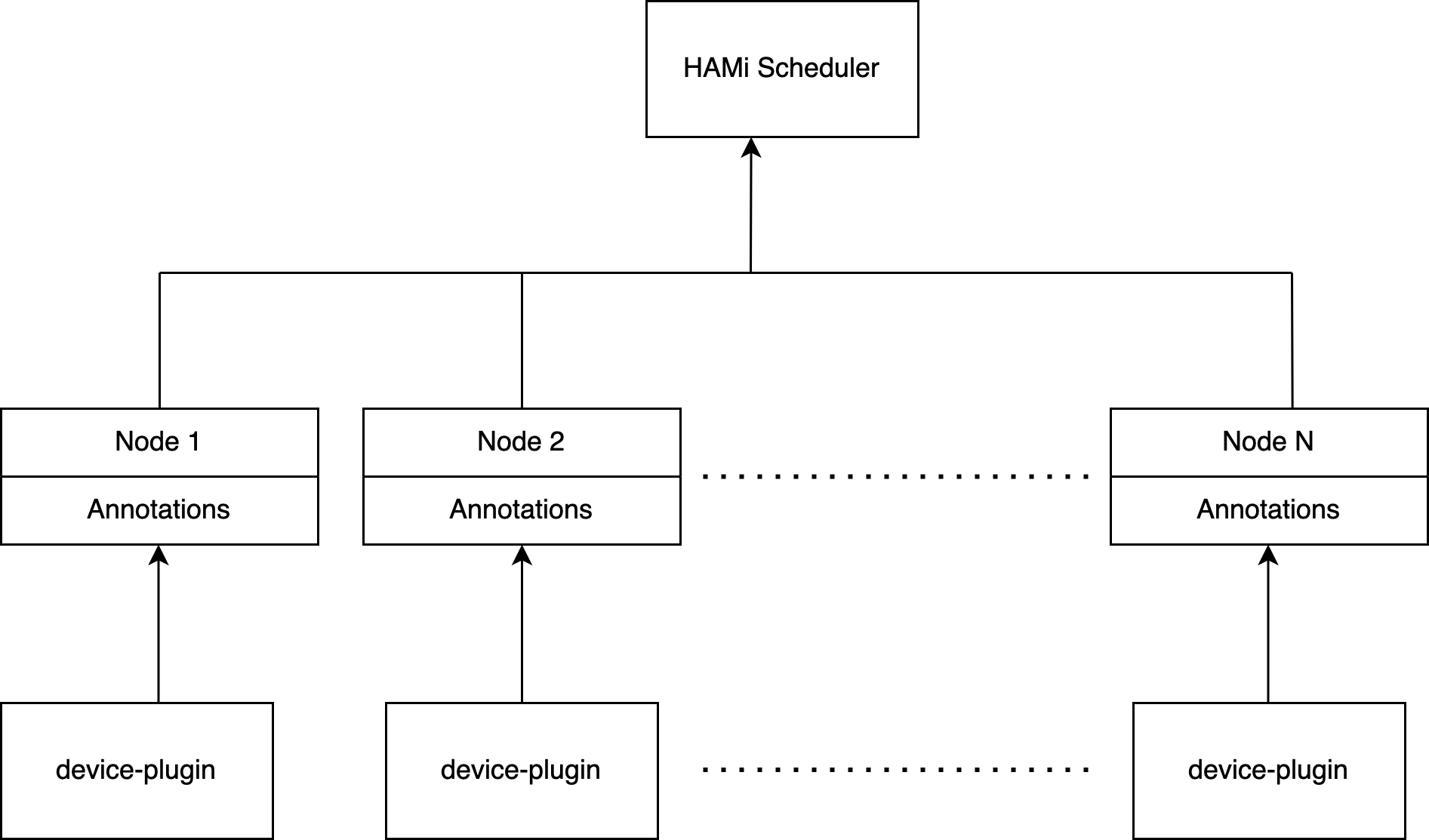
HAMi needs to know the spec of each AI device in the cluster to schedule properly. During device registration, device-plugin rescans its devices every 30 seconds and patches the spec of each device into node annotations, in the format of the following:
hami.io/node-handshake-\{device-type\}: Reported_\{device_node_current_timestamp\}
hami.io/node-\{device-type\}-register: \{Device 1\}:\{Device2\}:...:\{Device N\}
The definition of each device is in the following format:
\{Device UUID\},\{device split count\},\{device memory limit\},\{device core limit\},\{device type\},\{device numa\},\{healthy\}
The colon-separated form above is the legacy encoding, still used by device types decoded with DecodeNodeDevices (for example DCU and Iluvatar). NVIDIA and several other device types encode the same fields as a JSON array instead, one object per device, decoded with UnMarshalNodeDevices. Fields are serialized with omitempty, so zero and false values are absent rather than written out. See GPU Virtualization for a JSON example.
The annotation key is also not fully uniform: NVIDIA uses hami.io/node-nvidia-register and hami.io/node-handshake (no device-type suffix), while Kunlun uses hami.io/node-register-xpu.
An example is shown below:
hami.io/node-handshake: Requesting_2024-01-23 04:30:04.434037031 +0000 UTC m=+1104711.777756895
hami.io/node-handshake-mlu: Requesting_2024.01.10 04:06:57
hami.io/node-mlu-register: MLU-45013011-2257-0000-0000-000000000000,10,23308,0,MLU-MLU370-X4,0,false:MLU-54043011-2257-0000-0000-000000000000,10,23308,0,
hami.io/node-nvidia-register: GPU-00552014-5c87-89ac-b1a6-7b53aa24b0ec,10,32768,100,NVIDIA-Tesla V100-PCIE-32GB,0,true:GPU-0fc3eda5-e98b-a25b-5b0d-cf5c855d1448,10,32768,100,NVIDIA-Tesla V100-PCIE-32GB,0,true:
In this example, this node has two different AI devices, 2 Nvidia-V100 GPUs, and 2 Cambricon 370-X4 MLUs
A device node may become unavailable due to hardware or network failure. Since the system clock on the scheduler node and on the device node may not align properly, the scheduler owns the timestamp. Whenever the handshake annotation is absent or does not contain Requesting, the scheduler stamps it with its own clock.
hami.io/node-handshake-\{device-type\}: Requesting_{scheduler_node_current_timestamp}
The scheduler's registration loop runs every 15 seconds, and also on node events and on leader election changes. Only the elected leader performs registration.
A handshake is treated as expired once its timestamp is more than 60 seconds old. Expiry alone does not remove the node. The scheduler additionally requires the node's allocatable device count to have dropped to zero before it runs node cleanup, which removes the node's devices from the scheduler cache and deletes the handshake annotation. A node whose device-plugin is still reporting to kubelet therefore stays available even with an expired handshake.
Reported_ handshakeThe Reported_ side of this protocol is written by device-plugins that implement it. The in-tree NVIDIA device-plugin does not, so on an NVIDIA node the annotation normally stays at Requesting_<timestamp> and ages past 60 seconds. That is the expected steady state, not a fault: the effective liveness signal for NVIDIA is the allocatable device count. See GPU Nodes Not Registering.
